The website audit
Know exactly what’s wrong with your website, and what to fix first.
Commissioning a rebuild without an audit is like renovating without a survey.
We help business owners find out why their website isn’t winning trust from buyers or AI, and what to fix first, without committing to a rebuild.
Start here, free
Score your site in two minutes.
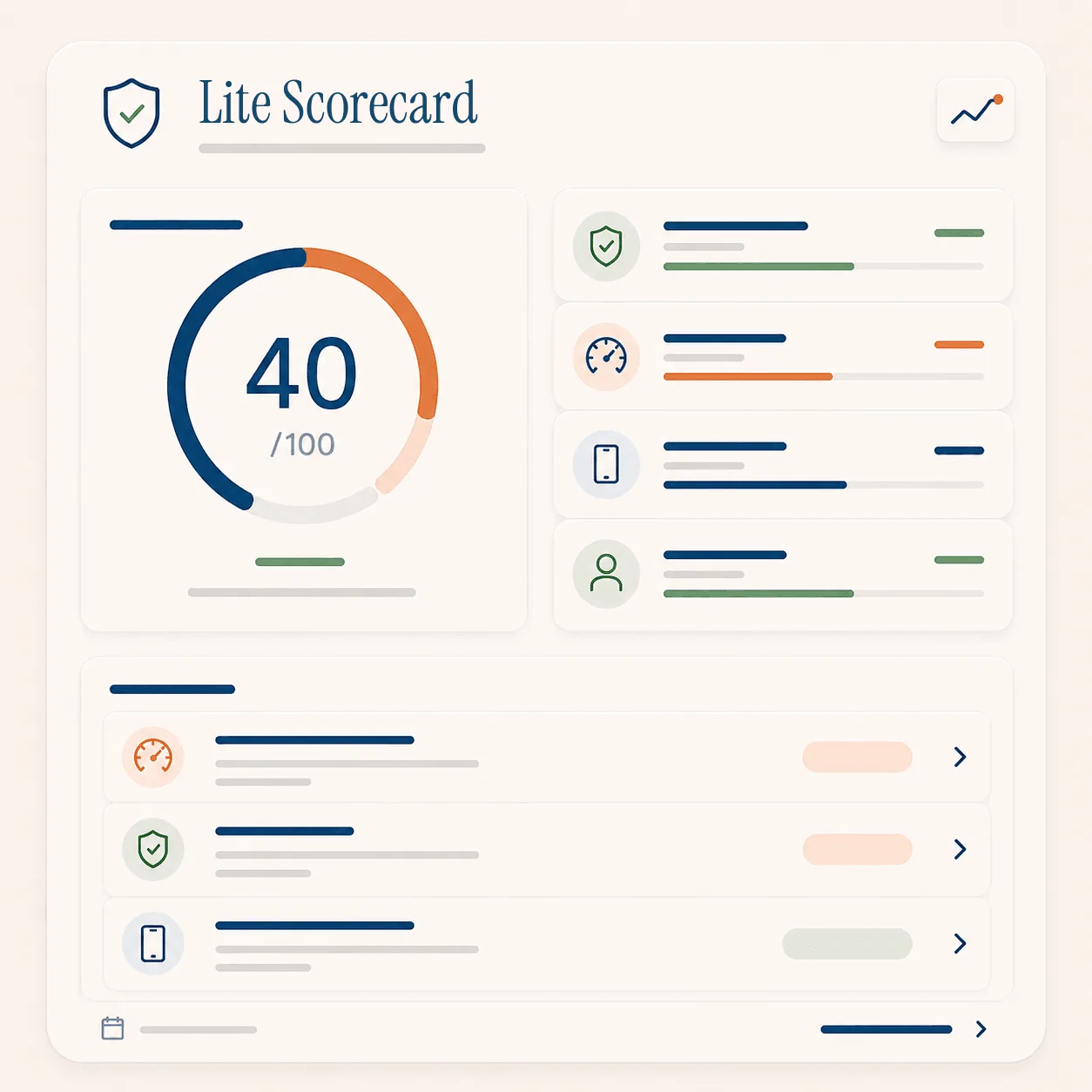
The Scorecard is a free, self-service version of our audit. Answer a short set of questions about your website and get an instant score, plus the three priority actions to take.
Most people run it expecting reassurance and discover something specific instead. That gap is the thing quietly costing you enquiries, and once you can see it, you can decide what to do about it.
Why consider doing an audit
Most website audits measure the wrong things.
A cheap automated audit
Measures what’s easy.
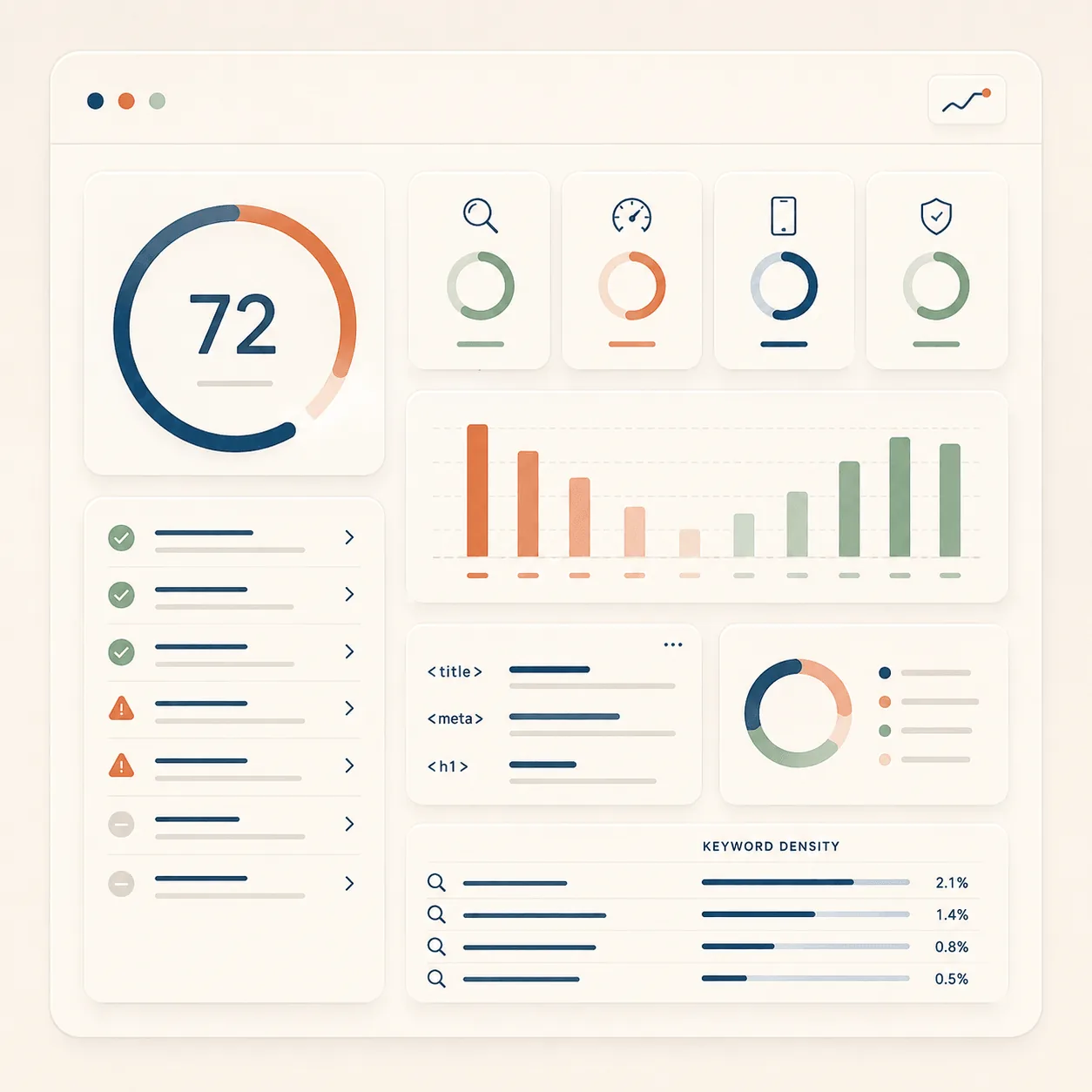
The Lighthouse-score, meta-tag crowd measure what’s easy to measure, not what makes a buyer choose. Page speed and keyword density don’t tell you why someone landed on your site and left without enquiring. Our framework scores the actual decision criteria, and a human reads your site. Different category of thing entirely.
A traditional agency “free audit”
Is a sales call in disguise.
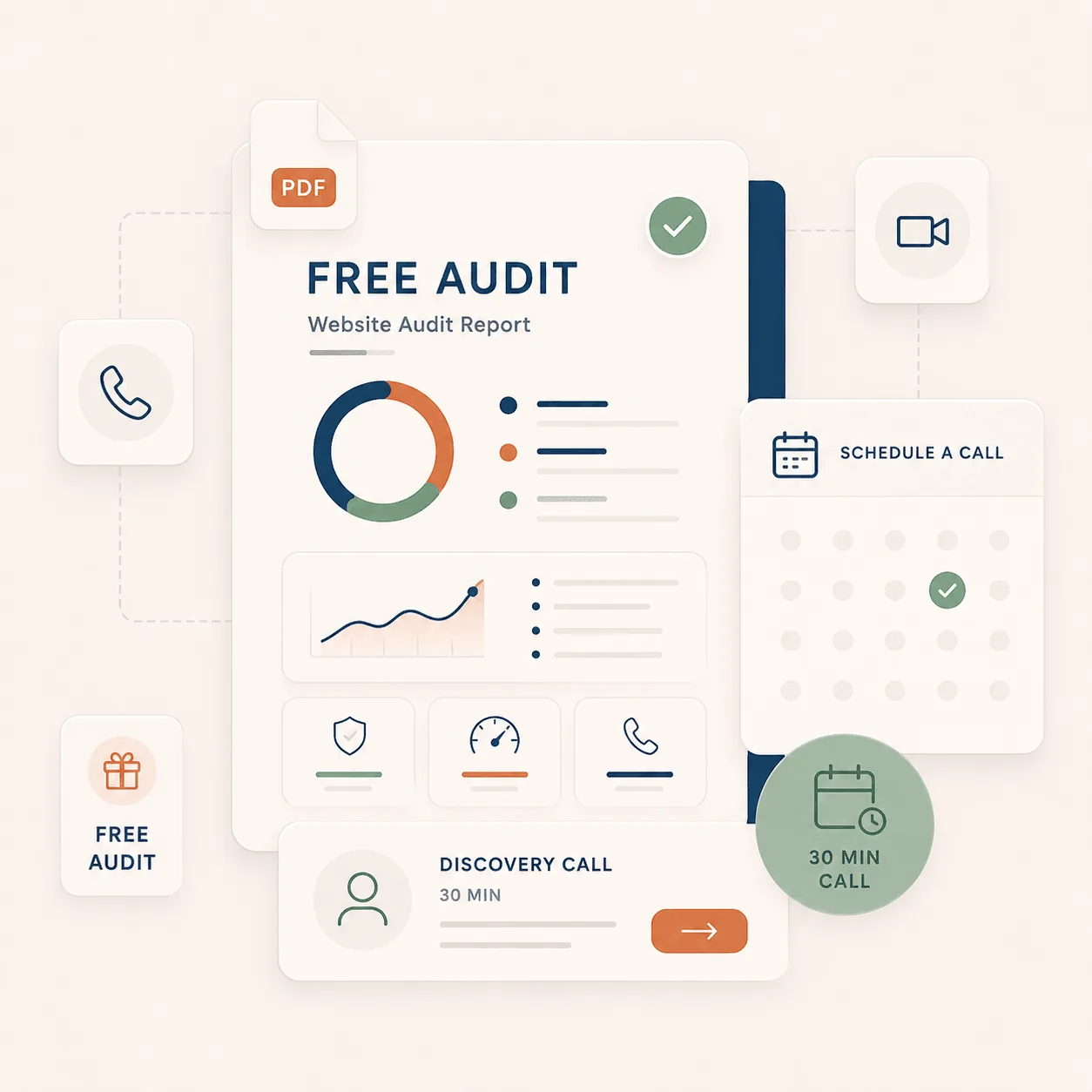
Theirs is a 30-minute sales call with a PDF attached, designed to sell you a retainer. Ours is a product you can take anywhere, with a build-credit that makes working with us opt-in rather than baited.
Doing nothing
The most expensive option, just invisibly.
A website that loses one enquiry a month to a fixable trust gap has cost you far more than the audit by year’s end. The free scorecard exists precisely so doing nothing stops being comfortable: it turns “my site’s probably fine” into a specific score you can’t unsee.
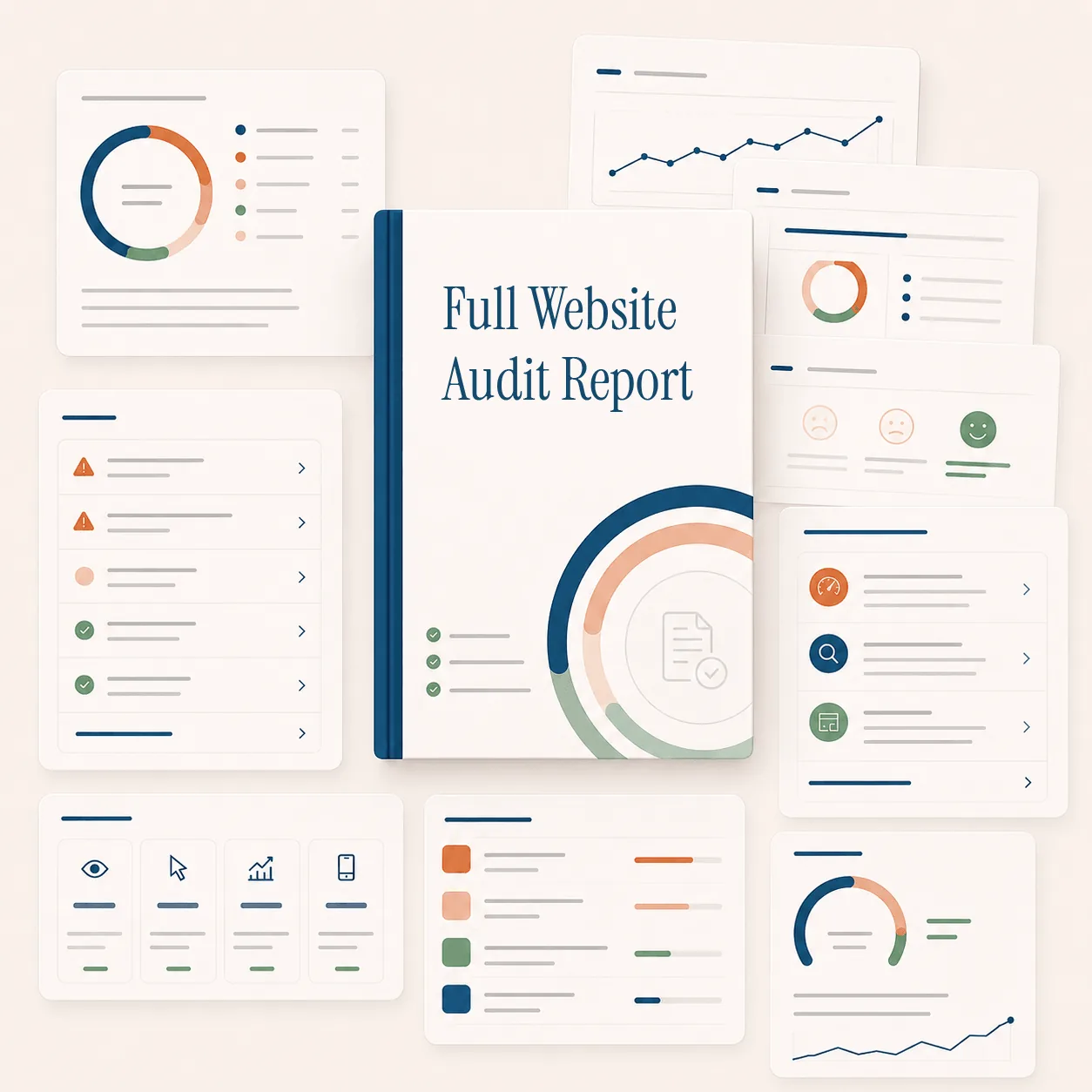
Four deliverables, one clear picture
The Full Audit.
Your site scored against the Confident Buyer Framework.
Ten categories, ten statements each, scored on observable evidence on your website. You see exactly where your website is strong and where the work needs to happen.
An AI-visibility snapshot.
How your site currently appears, or fails to appear, to AI recommendation systems. In 2026 this is the difference between being recommended and being invisible.
A written report and walkthrough.
A PDF report that we can walk you through on a video call, or in a recorded video that you can watch in your own time.
A priority-ranked fix list.
The executive summary opens with the three actions that matter most, so you know where to start. Below that, every recommendation is rated high, medium, or low by impact.
Three ways in
Start free. Go deeper when you’re ready.
Tier 1
Scorecard.
Two minutes, no call, no commitment.
A self-service score across the ten categories, plus your single biggest gap. The fastest way to find out whether you have a problem worth fixing.
- Score across all ten categories
- Your single biggest gap, named
- Instant, self-service
Tier 2
The Audit.
The full diagnosis.
Includes
- Full Confident Buyer Framework score
- AI-visibility snapshot
- Written report + walkthrough
- Priority-ranked fix list, top three up front
- Delivered in seven days, fixed price
Tier 3
Audit + Roadmap.
The route to the cure.
For when you’ve decided to act, not just diagnose.
Everything in the Audit, plus
- A sequenced implementation roadmap: what to fix in what order, grouped into phases with a rough, effort-based timeline.
- Low-impact items batched into a single “tidy up later” phase rather than padding the plan.
- Five worked “what good looks like” examples, drawn from your weakest categories, showing the specific direction each fix should take on your actual pages.
The guarantee: worth it or it’s free.
Complete the audit, and if we genuinely don’t surface at least 10 specific, actionable issues worth fixing, you don’t pay. The risk is ours, not yours.
If you go on to a website redesign with us within 60 days, the investment comes off the build price. For anyone who was always going to rebuild, the audit effectively costs nothing: you’ve paid a deposit, not a fee.
FAQs
Questions people ask before they book.
Fair question, it’s the default suspicion, and you’ve earned it from every agency whose “free audit” was a sales call with a PDF stapled on. So we built the opposite. The audit is a paid product, which means we’re not recouping our time by selling you something afterwards. You’ve paid for the work, and it’s yours: fix the issues yourself, hand them to your current developer, take them to a competitor of ours. The report is written to be useful to whoever does the work, not just to us. And if you do decide to build with us, your fee comes off the price, so the one path where we benefit is the one where you’ve saved money. Some audit clients go on to a build. Some don’t. Both are genuinely fine.
Start with ours, the free Scorecard takes two minutes. But here’s what every automated tool measures: page speed, mobile-friendliness, meta tags. Things a machine can read. None of which is why a buyer landed on your site and left without enquiring. A buyer doesn’t bounce because your meta description is short; they bounce because they couldn’t tell within five seconds that you solve their problem, couldn’t find a price, or saw no proof you’d done this before. No automated tool scores that, because it takes a human reading your site the way a buyer does. Free tools score the technical layer, which is one category out of our ten. The other nine are the difference.
The thing that makes most audits useless is the thing we engineered out. Hand someone forty problems and they freeze, so nothing gets done. That’s why the entire deliverable is ranked, not listed. You don’t get forty things, you get a first thing: the one fix that changes a buyer’s first impression or repairs a trust signal AI is currently missing. Then the second. The report is built as an order of operations, an executive summary with the three things to fix first, then everything else sequenced by priority, precisely so it becomes a to-do list, not a drawer-filler.
You might well rebuild, and if you do it with us, this becomes free, as it comes off the build price. But commissioning a rebuild without a diagnosis is like renovating a house without a survey. You’ll spend four or five figures, and without knowing what’s actually losing you enquiries, you risk two expensive mistakes: rebuilding the parts that already worked, and faithfully reproducing the blind spots that were costing you buyers, now in a prettier wrapper. £500 and seven days tells you what genuinely needs to change before you spend the big money. It’s not a cost on top of the rebuild. It’s what stops the rebuild being a guess.
The market’s full of “proprietary frameworks” that are one person’s opinion with a logo on it, so it’s a reasonable thing to ask. Here’s exactly what ours is: ten categories, ten yes/no statements each, every one scored on observable evidence on your site, not our impression of it. “Is there a price on the site, yes or no.” “Is there a named author on the blog, yes or no.” You can read the criteria before you buy and check our scoring against your own site afterward. It isn’t our opinion of your website; it’s a hundred specific, checkable facts about it. If anything, it’s less subjective than the gut-feel audit you’d get elsewhere.
Two different situations. If you genuinely don’t like it: tell us, and we’ll talk it through on a call. If the issue is that we misread something about your business, we’ll revise the affected section. If the issue is that the report told you things you didn’t want to hear, that’s a different conversation, the framework is the framework, and a site that scores 38% scores 38%. We don’t soften scores to keep clients comfortable, because honest audits are the only kind worth paying for.
And if we genuinely can’t surface at least ten specific, actionable issues worth fixing, you don’t pay, that’s the guarantee, in full below. I’ll be honest about why I can offer it: against a hundred-point framework, we’ve never seen a site without them, including very good ones. A site scoring 80 out of 100 still has twenty fixable gaps, and the ones at the top of that list are often the highest-value of all, because everything else is already working.
The brief takes about fifteen minutes, and that’s the only time you spend, we do the rest and have it back in seven days. Set that against the alternative: every month you leave it, the site carries on losing the enquiries it’s losing now, silently, with no diagnosis. Fifteen minutes is the cheapest this problem will ever be to look at.
Yes. The report is yours, and the fixes are specific enough that any developer, or whoever runs your content, can action them directly. You’re not locked into us for the work.
No. We audit any B2B or B2C website regardless of whether we’d be the right team to rebuild it. Some sites we audit are on WordPress, which we don’t build in. Some are large e-commerce sites. Some are in sectors we don’t typically work in. The audit doesn’t require us to be the rebuild team, and the report is structured so any competent agency could action it.
Within two business days of booking, in most weeks. The audit itself takes seven business days from the day you submit the brief, so the worst case is around nine days from payment to report. We take a fixed number of audits each month so the analysis stays hands-on and read by a person, not outsourced or run through a tool, so if a month is full we’ll tell you before taking payment and you’ll join the next.
The entire website, within reason. For most sites that’s the homepage, all service pages, about and team pages, pricing if it exists, contact, FAQ, and the blog hub. For very large sites (100+ pages) we audit a representative sample and tell you which. We’re scoring the site as a buyer would experience it, not crawling every URL.
Then the audit isn’t the right service yet. Wait until the site has been live a few weeks, so AI has had a chance to index it. If you’re still mid-build, book the briefing call instead and we’ll talk about whether to start with a Websites engagement or wait and audit the finished build.
Share it within your business however you like, with your team, your developer, your agency, whoever’s actioning the fixes. We’d just ask you not to publish it publicly, since it might include commercial commentary on named competitors that wouldn’t necessarily be in their interest to have online. Internal sharing, yes. LinkedIn, no.
Same framework, same scoring. Your site rescored against your original benchmark, so you see what’s improved and what hasn’t. It’s a short report focused on what’s changed rather than a rewrite of the original, which is why it’s £250: the framework mapping is already done from the first audit.
It’s a relative plan, not a calendar. The roadmap sequences the work into phases and estimates the effort each phase takes, but the clock starts when you do. We deliberately don’t put dates against it, because the timeline depends on your pace, not ours, and a plan with fake deadlines is worse than one with honest phasing.
Fill out the audit request form on the contact page and you’ll have the briefing form within 24 hours. From there, seven days to your report.
Taking on new projects for September
Two ways to start. Neither is a sales call.
Book your audit. The full diagnosis, back in seven days.
Worth it or it’s free.
Not sure yet? Score your site free in two minutes. You’ll see where you’re strong, where you’re losing buyers, and whether the full audit is worth it for you.